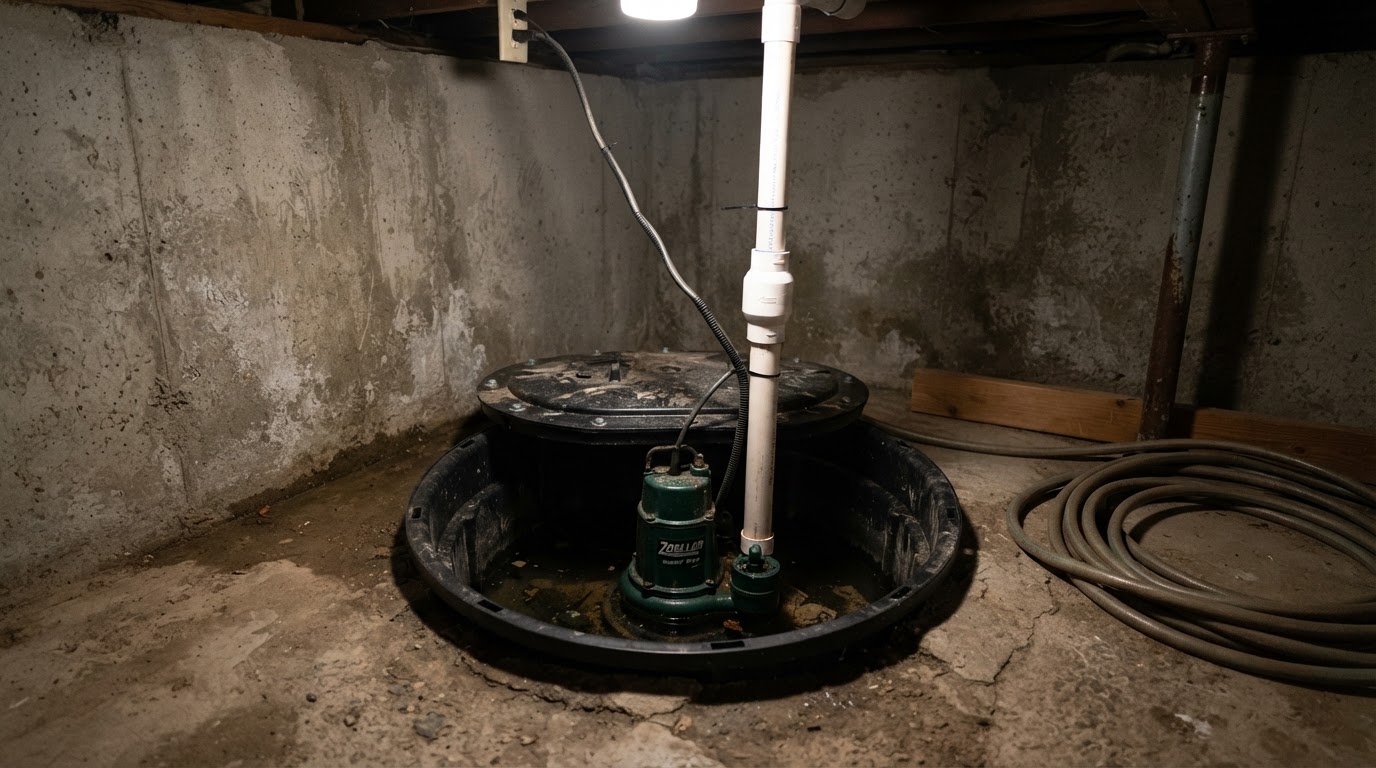
A sump pump that runs constantly is doing its job — but it's also sending you a message. Pumps are meant to cycle on and off as water collects, not run for hours on end. When yours never seems to stop, something is either feeding it too much water or the pump itself isn't switching off the way it should. Here's how to tell the difference and what to do about it.
Cause 1: There's Just a Lot of Water
The most common reason a pump runs nonstop is that there's a lot of groundwater reaching the basin. A high water table, heavy clay soil saturated after a storm, or spring snowmelt can all keep water flowing in faster than the pump can fully clear it. If the pump only runs constantly during wet weather and settles down when it's dry, the pump is probably fine — the drainage around your home is the real issue.
In southeastern Wisconsin, the heavy glacial clay holds water against foundation walls and releases it slowly, so a pump can keep busy for days after a big rain. That's hard on the pump and on your electric bill, and it's a sign that managing water at the source — gutters, downspout extensions, grading, or an interior drain tile system — would help.
Cause 2: A Stuck or Misadjusted Float Switch
The float switch is what tells the pump when to turn on and off. If the switch gets stuck in the 'on' position — tangled on the basin wall, jammed by debris, or obstructed by the pump's own cord — the pump runs even when the basin is empty. This is one of the most common pump failures, and it can burn out a motor quickly if the pump runs dry.
A misadjusted switch can also cause short cycling: the pump turns on and off every few seconds because it's set to trigger at too low a water level. If you hear rapid clicking on and off, the switch position or a worn switch is a likely culprit.
Cause 3: A Frozen or Blocked Discharge Line
If the discharge line — the pipe that carries water away from the house — is frozen, clogged with debris, or blocked at its outlet, the pumped water has nowhere to go. The pump runs, but water either backs up or recirculates right back into the basin, so the pump never makes progress and never shuts off. In a Wisconsin winter, a frozen discharge line is a frequent cause of constant running.
Check that the discharge line exits well away from the foundation, is pitched so it drains, and isn't buried where it can freeze. A frozen line is an urgent problem: the pump can overheat and fail exactly when you need it most.
Cause 4: A Worn-Out or Undersized Pump
Pumps don't last forever. A motor that's wearing out may run longer to move the same amount of water, and an undersized pump may simply not keep up with the inflow. If your pump is old, loud, vibrating more than it used to, or running longer cycles than it did a year ago, it may be time for a replacement rather than a repair.
A pump that runs constantly is also a pump that's one power outage away from failing. If yours never rests, a battery backup is worth serious consideration — it keeps the pump running when the power drops, which is exactly when storms tend to knock it out.
When to Worry and What to Do
Worry when the pump runs constantly even in dry weather, runs while the basin is empty, short-cycles rapidly, makes grinding or humming noises, or has a frozen discharge line in winter. Any of these can lead to a burned-out motor or a flooded basement. Start by checking the float switch and discharge line yourself, but if the problem isn't obvious, call for a professional look.
The fix might be a switch replacement, a new discharge line, a larger pump, or — if the real issue is the volume of water — a drainage upgrade so the pump doesn't have to work so hard. We'll tell you honestly which one you need.
Frequently Asked Questions
Is it bad if my sump pump runs every 30 seconds?
Yes, that's short cycling and it's hard on the pump. It usually means the float switch is set too low, the switch is worn, or the basin is too small for the inflow. Constant short cycling wears out the motor and the switch faster. It's worth having the switch and basin setup checked before it leads to a failure.
Should my sump pump run when it hasn't rained?
Occasionally, yes — a high water table or slow clay drainage can keep water trickling in for days after rain. But if your pump runs constantly during a dry stretch with no recent rain, something else is wrong: a stuck float, a leaking water pipe feeding the basin, or a blocked discharge line recirculating water. That's worth investigating.
How do I keep my sump pump from failing during a storm?
Test the pump before storm season by pouring water into the basin and watching it cycle. Make sure the discharge line is clear and not frozen. Consider a battery backup so the pump runs during a power outage, which is when storms often hit. And if the pump runs constantly even in normal weather, get it serviced before the next big storm — that's when a tired pump is most likely to give out.